Tadalafil Regimens • Daily vs On‑Demand

Daily vs On‑Demand — Comparing Two Tadalafil Regimens

Daily tadalafil uses low doses such as Tadalafil 5 mg (and 2.5 mg) taken every day to maintain a steady baseline effect, while On‑Demand relies on medium or high doses like Tadalafil 20 mg taken before planned activity. Both regimens share the same active ingredient and mechanism, but differ in purpose, onset expectations, and tolerability. Daily therapy offers stable readiness and consistent support, while On‑Demand provides stronger intensity for episodic use. Onset typically ranges from 20–45 minutes, duration may reach up to 36 hours, and each regimen suits different user needs depending on lifestyle, frequency, and preferred dosing format.

Daily vs On‑Demand: Quick Definition
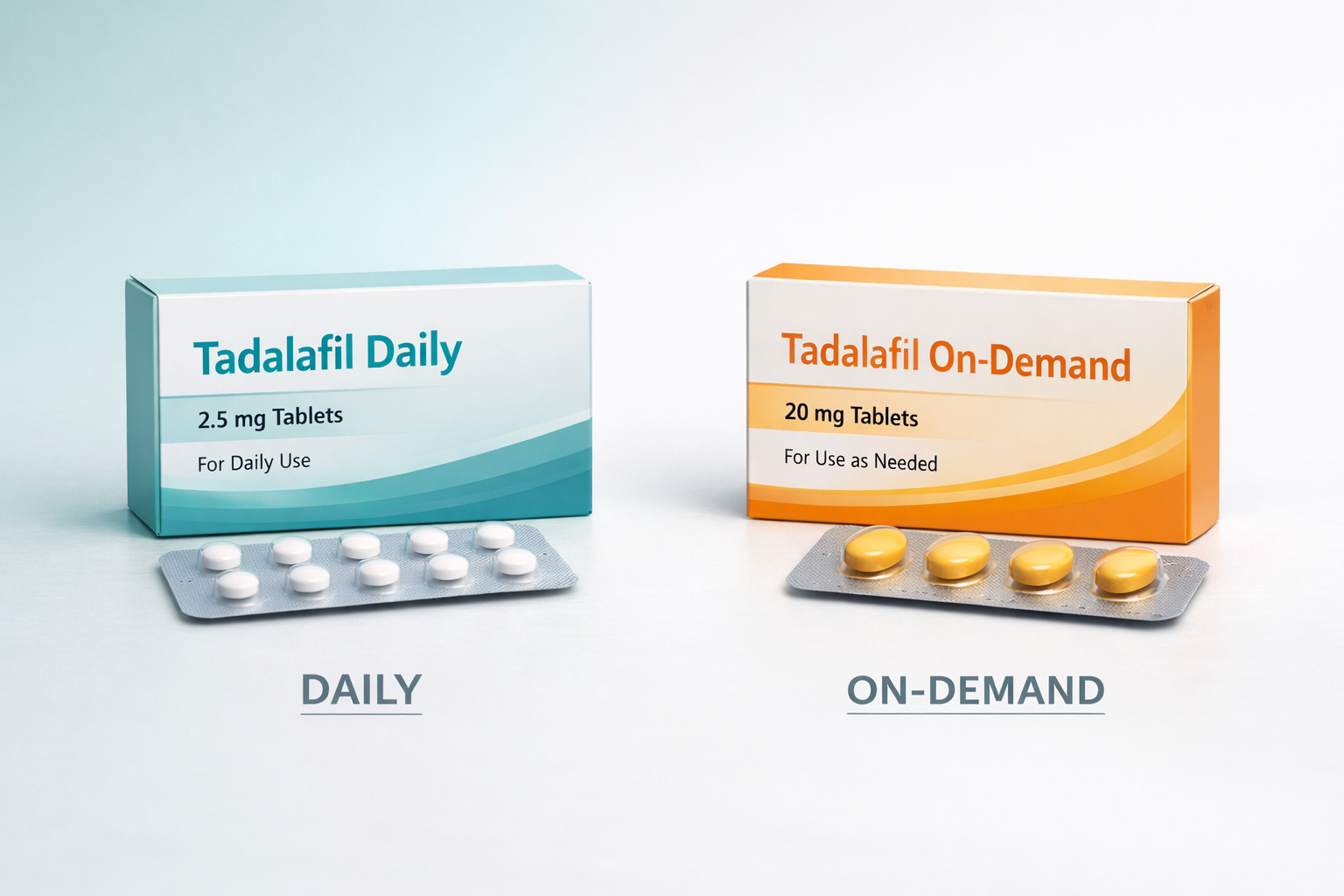
Tadalafil Daily vs On‑Demand

Daily tadalafil refers to the continuous use of low‑dose strengths (2.5 mg or 5 mg) taken once per day. This regimen maintains a stable level of tadalafil in the bloodstream, allowing sexual activity at any moment without timing the dose. Daily therapy is chosen by users who prefer spontaneity, smoother tolerability, and consistent therapeutic support throughout the day.

On‑Demand tadalafil is taken only when needed, typically in mid‑dose or high‑dose strengths (10 mg or 20 mg). This regimen provides a strong peak effect within a defined window, usually activated 20–45 minutes after intake. On‑demand dosing is preferred by users who engage in intimacy less frequently or want a more pronounced effect during specific occasions.

Both regimens rely on the same active ingredient but differ in timing, dose strength, and lifestyle fit. Daily dosing offers stability and convenience, while on‑demand dosing offers intensity and flexibility. More information is available in Tadalafil Overview and the Indian Brands List.

Choosing between daily and on‑demand depends on frequency of intimacy, desired spontaneity, and personal tolerability.

Daily vs On‑Demand Dosage Comparison

Daily tadalafil uses 2.5 mg or 5 mg once per day. These low‑dose strengths are designed to maintain a steady plasma level, reducing fluctuations and minimizing side‑effect intensity. Daily dosing is ideal for users who prefer spontaneity or require continuous therapeutic support.

On‑Demand tadalafil uses 10 mg or 20 mg taken before sexual activity. These mid‑dose and high‑dose strengths provide a stronger peak effect and are intended for episodic use. On‑demand dosing suits users who engage in intimacy less frequently or prefer medication only when needed.

The difference in strength directly affects onset, duration, and tolerability. Low‑dose daily regimens offer smoother, more predictable tolerability, while mid/high‑dose on‑demand regimens deliver a more pronounced effect but may produce stronger side effects.

The table below summarizes the dosage differences.

Dose Regimen Onset Duration Notes
2.5 mg Daily 20–45 minutes Stable all day Micro‑dose; minimal side effects
5 mg Daily 20–45 minutes Stable all day Most common daily strength
10 mg On‑Demand 20–45 minutes Up to 36 hours Moderate on‑demand dose
20 mg On‑Demand 20–45 minutes Up to 36 hours Full on‑demand strength

Onset: Daily vs On‑Demand

Daily tadalafil produces a soft, gradual onset without a pronounced peak. Because low‑dose strengths (2.5 mg and 5 mg) are taken every day, tadalafil maintains a stable plasma level, meaning users do not experience a sudden activation. Instead, the effect is continuously present, allowing sexual activity at any moment without timing the dose.

On‑Demand tadalafil activates within 20–45 minutes, depending on metabolism, food intake, and dosage. Mid‑dose and high‑dose strengths (10 mg and 20 mg) create a noticeable peak effect. Some fast‑acting formats — such as chewable, soft tabs, or sublingual versions — may shorten onset slightly, though the core pharmacokinetics remain similar.

More details on tadalafil timing are available in Tadalafil Duration.

The table below summarizes onset differences.

Regimen Typical Onset Notes
Daily Soft, continuous No peak; stable plasma level
On‑Demand 20–45 minutes Peak effect; faster with chewable/soft tabs/sublingual

Duration: Daily vs On‑Demand

Daily tadalafil maintains a stable therapeutic level throughout the day, providing a functional duration of 24–36 hours. Because the medication is taken every day, its effect does not “wear off” in the traditional sense — instead, users experience continuous support with minimal fluctuations. This makes daily dosing ideal for those who prefer spontaneity and predictable performance.

On‑Demand tadalafil delivers a duration of up to 36 hours, driven by tadalafil’s long half‑life. The strength of the dose influences how pronounced the effect feels: 10 mg provides moderate support, while 20 mg offers a stronger and more noticeable effect. Despite these differences, the overall duration window remains similar across on‑demand strengths.

The main distinction is that daily dosing provides continuous coverage, while on‑demand dosing provides episodic coverage tied to a single dose.

The table below summarizes duration differences.

Regimen Duration Notes
Daily 24–36 hours Stable level; continuous effect
On‑Demand Up to 36 hours Single‑dose effect; strength influences intensity

Effectiveness: Daily vs On‑Demand

Daily tadalafil provides stable, predictable effectiveness by maintaining a constant therapeutic level. Users experience smoother tolerability, fewer fluctuations, and the ability to engage in sexual activity at any time. This regimen is ideal for individuals with frequent intimacy or those who prefer not to plan around medication timing.

On‑Demand tadalafil offers maximum strength and intensity, especially at 20 mg. The effect is more pronounced, making it suitable for episodic use or for users who prefer a stronger peak response. However, mid/high‑dose strengths may produce more noticeable side effects compared with daily micro‑doses.

The choice between regimens depends on lifestyle: daily dosing for regular, spontaneous activity; on‑demand dosing for occasional, planned use with stronger effect.

Safety & Side Effects

Daily tadalafil typically produces minimal side effects due to its low‑dose strengths (2.5 mg and 5 mg). Users often report smoother tolerability, fewer headaches, and reduced flushing. Continuous dosing also avoids the sharp peaks associated with higher strengths.

On‑Demand tadalafil, especially at 20 mg, may produce more noticeable side effects such as headache, flushing, nasal congestion, or muscle aches. These effects are dose‑dependent and more common with high‑dose episodic use. Nonetheless, they remain within the typical safety profile of tadalafil.

Interactions are identical for both regimens, including contraindications with nitrates, NO‑donors, alpha‑blockers, and CYP3A4 inhibitors. More detailed safety information is available in Side Effects & Interactions.

Overall, daily dosing offers smoother tolerability, while on‑demand dosing offers stronger effect with potentially stronger side effects.

Key Differences: Daily vs On‑Demand

Daily and On‑Demand tadalafil regimens differ across several core parameters, including dosage strength, onset characteristics, duration, tolerability, and intended use. Daily tadalafil uses low‑dose strengths (2.5 mg or 5 mg) taken once per day, creating a stable therapeutic level without sharp peaks. This results in smoother tolerability and continuous readiness. On‑Demand tadalafil, taken only before sexual activity, uses mid‑dose or high‑dose strengths (10 mg or 20 mg) and produces a stronger, more noticeable peak effect.

Onset also differs: daily dosing provides a soft, continuous onset with no defined activation moment, while on‑demand dosing activates within 20–45 minutes. Duration is similar for both regimens — up to 36 hours — but daily dosing maintains effect through constant plasma levels, whereas on‑demand dosing provides a single‑dose window.

Tolerability tends to be smoother with daily micro‑doses, while on‑demand mid/high doses may produce more noticeable side effects. Purpose of use is the final differentiator: daily dosing suits users who prefer spontaneity and regular support, while on‑demand dosing suits those who want maximum strength for episodic use.

The table below summarizes the key differences.

Parameter Daily On‑Demand Notes
Dosages 2.5 mg, 5 mg 10 mg, 20 mg Low‑dose vs mid/high‑dose
Onset Soft, continuous 20–45 minutes Fast‑acting forms may shorten onset
Duration 24–36 hours (continuous) Up to 36 hours Single‑dose window
Tolerability Smoother, minimal side effects Stronger side effects at high dose Dose‑dependent
Purpose Regular, spontaneous activity Episodic, planned use Different lifestyle fit

Who Each Regimen Suits

Daily tadalafil is ideal for users who prefer stability, regularity, and a soft therapeutic effect. Because low‑dose strengths maintain a constant plasma level, daily dosing suits individuals with frequent intimacy or those who want predictable readiness without planning around medication timing.

On‑Demand tadalafil is best suited for users who prefer episodic use and maximum strength. Mid‑dose and high‑dose strengths (10 mg and 20 mg) provide a pronounced peak effect, making this regimen ideal for occasional intimacy or for users who want a stronger response during specific moments.

Choosing between daily and on‑demand depends on lifestyle: daily dosing for spontaneous, regular activity; on‑demand dosing for planned, episodic use with stronger intensity.

Legitimacy: Daily vs On‑Demand

Both Daily and On‑Demand tadalafil regimens are fully legitimate when produced by GMP‑certified manufacturers. GMP certification ensures regulated production, consistent potency, and adherence to pharmaceutical quality standards regardless of dosage strength or regimen.

Because both regimens rely on the same active ingredient — tadalafil — they are considered pharmaceutically equivalent when taken at equal total daily dosage. The differences lie in lifestyle fit, dose strength, and brand positioning rather than legitimacy or therapeutic effect.

Individual brands may differ in excipients, form variety, or distribution channels, but both daily and on‑demand approaches remain equally valid and clinically recognized.

Tadalafil Daily vs On‑Demand FAQ

Daily tadalafil uses low doses taken every day to maintain steady readiness, while on‑demand uses higher doses taken before planned activity. Both rely on the same active ingredient, but differ in purpose, intensity, and how consistently the effect is maintained.

Neither regimen is universally better. Daily suits users who prefer spontaneous readiness and frequent activity, while on‑demand suits those who want stronger episodic intensity. Both work identically, so the choice depends on lifestyle and dosing preference.

Daily therapy typically uses low doses such as 2.5 mg or 5 mg taken once per day. These doses maintain stable plasma levels and provide continuous support without the need for timing around activity.

On‑demand therapy uses medium or high doses such as 10 mg or 20 mg taken before planned activity. These doses provide stronger intensity and are intended for episodic use rather than daily intake.

Onset is generally similar for both regimens, typically 20–45 minutes. Daily dosing provides a constant baseline, while on‑demand requires timing before activity. The pharmacological activation remains the same.

No, both daily and on‑demand tadalafil can last up to 36 hours. Duration is a property of tadalafil itself. Differences relate more to dosing strategy than to how long the effect persists.

Side effects are similar because both regimens use tadalafil. Daily dosing may produce steadier tolerability, while on‑demand may cause stronger intensity‑related reactions. Overall profiles remain comparable across both approaches.

Many users transition between regimens depending on lifestyle and frequency of activity. Switching is common, but should be done thoughtfully to ensure the new dosing pattern aligns with personal needs and tolerability.

Daily and on‑demand regimens are not typically combined, as each is designed for a specific dosing strategy. Using both simultaneously may increase exposure without added benefit, so most users choose one consistent approach.

No, both use the same active ingredient and work identically. Differences relate to branding, excipients, and manufacturer reputation, not the pharmacological effect of daily tadalafil therapy.

No, both rely on the same tadalafil mechanism and provide identical on‑demand performance. Variations are limited to branding and formulation, not the core effect or duration.

Choosing depends on lifestyle, frequency of activity, and preferred dosing style. Daily suits users who want spontaneous readiness, while on‑demand suits those who prefer stronger episodic intensity. Both work identically, so selection is based on personal needs.

Full FAQ: Tadalafil Daily vs On‑Demand FAQ

PubMed FDA EMA NCBI Bookshelf ClinicalTrials.gov